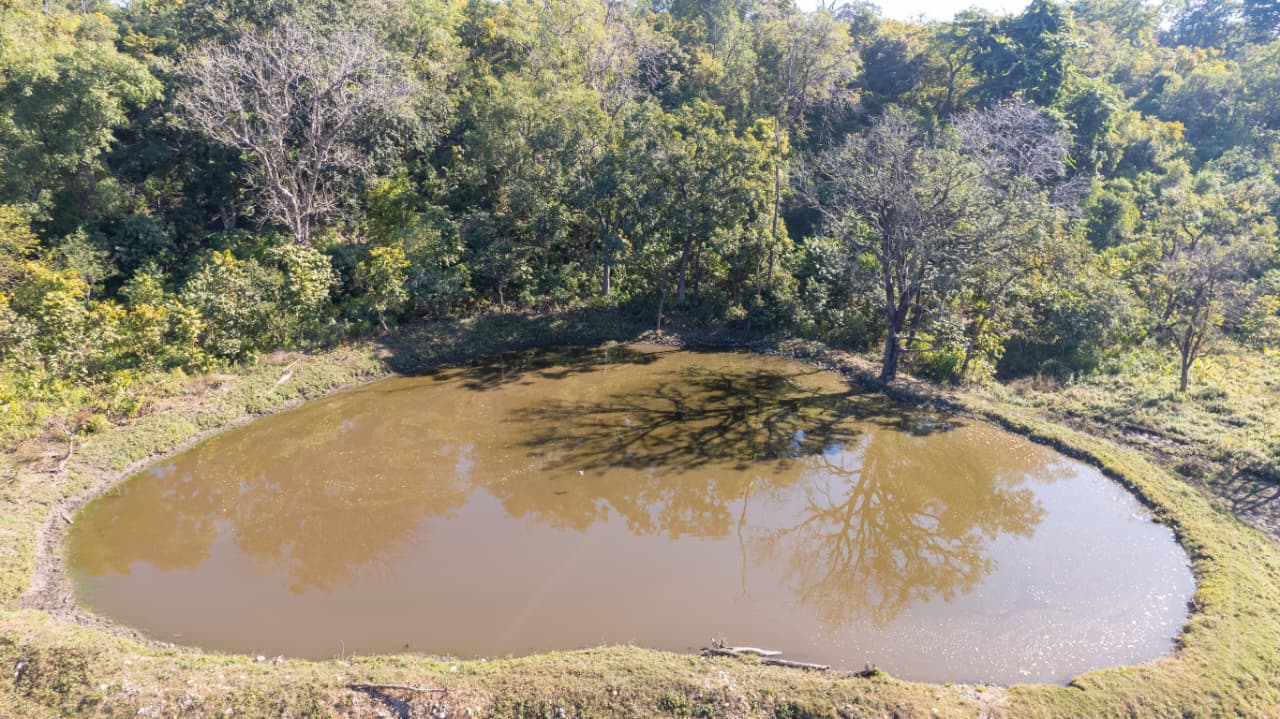
Dehradun: Forest: Environment: Water scarcity: A significant picture regarding Uttarakhand’s forests has emerged for the first time. The Forest Department has compiled data on the availability of water resources within the forests. For the first time, this data reveals the volume of water present in the forest water bodies. It also sheds light on the impact of projects implemented to increase water availability in the forests.
Data on water availability in forests compiled for the first time
Statistics regarding the status of Uttarakhand’s forest areas and their associated water resources present a significant picture. A consistent increase in water availability across reservoirs, tanks, and ponds has been recorded between the years 2022-23 and 2024-25. Notably, the volume of water in tanks and ponds has more than doubled over this three-year period, while water availability in reservoirs has also risen.
Increase in water in forest areas
Available data indicates that while the combined water availability in reservoirs and ponds stood at approximately 62.3 million cubic meters in 2022–23, it rose to about 126.3 million cubic meters in 2024–25.
Water availability in 2022-2023
According to the data, water availability in reservoirs during the year 2022-23 was recorded at 0.000349725 BCM. When converted to crore cubic meters, this quantity amounts to approximately 0.03497 crore cubic meters. In the same year, the water available in tanks and ponds was 0.061904362 BCM—that is, approximately 6.19 crore cubic meters. Thus, the total water available from both sources combined stood at approximately 6.23 crore cubic meters.
Water in 2023-24
In the following year, 2023-24, water availability in reservoirs rose to 0.000622186 BCM (approximately 0.06222 crore cubic meters). Meanwhile, water availability in tanks and ponds reached 0.105790749 BCM (approximately 10.58 crore cubic meters). This represents an increase of nearly 71 percent in water availability in tanks and ponds within a single year. Water availability in reservoirs also saw a rise of approximately 78 percent. Combining both sources, total water availability reached approximately 10.64 crore cubic meters in 2023-24.
Data for the year 2024-25
Figures for 2024-25 further highlight this increase. Water availability in reservoirs for the year was recorded at 0.000889310 BCM—approximately 0.08893 crore cubic meters. Meanwhile, the volume of water in tanks and ponds stood at 0.125445707 BCM, or roughly 12.54 crore cubic meters. Combining both sources brings the total availability to approximately 12.63 crore cubic meters.
Water levels in reservoirs increased by 154 percent
A comparison of the data reveals that the water available in tanks and ponds rose by approximately 6.35 crore cubic meters in 2024-25 compared to 2022-23. In percentage terms, this represents an increase of about 103 percent; effectively, the water available in these sources more than doubled over the two-year period. Meanwhile, water availability in reservoirs also increased by approximately 0.054 crore cubic meters, marking a rise of about 154 percent.
Adequate water reduces risks for wildlife
These figures are particularly significant for forest areas because the various water sources found within them ranging from small to large play a crucial role in sustaining wildlife, flora, and the surrounding ecosystem. When natural water sources deplete during the summer, reservoirs, ponds, and other water structures become vital sources of water for wildlife. Sufficient water availability can reduce the need for wildlife to venture out of the forest into inhabited areas in search of water; this is directly linked to efforts aimed at mitigating human-wildlife conflict.
Data indicating water management potential
These figures can be viewed in the context of the potential for water conservation within forest areas. Regular maintenance of existing water structures in forest areas and wildlife habitats, along with rainwater harvesting and the rejuvenation of natural water sources, could help ensure water availability during the summer months. Furthermore, if future data on water availability is recorded by forest division and water source, it would be easier to identify which forest divisions or wildlife areas have better water conditions and which require additional water conservation measures.