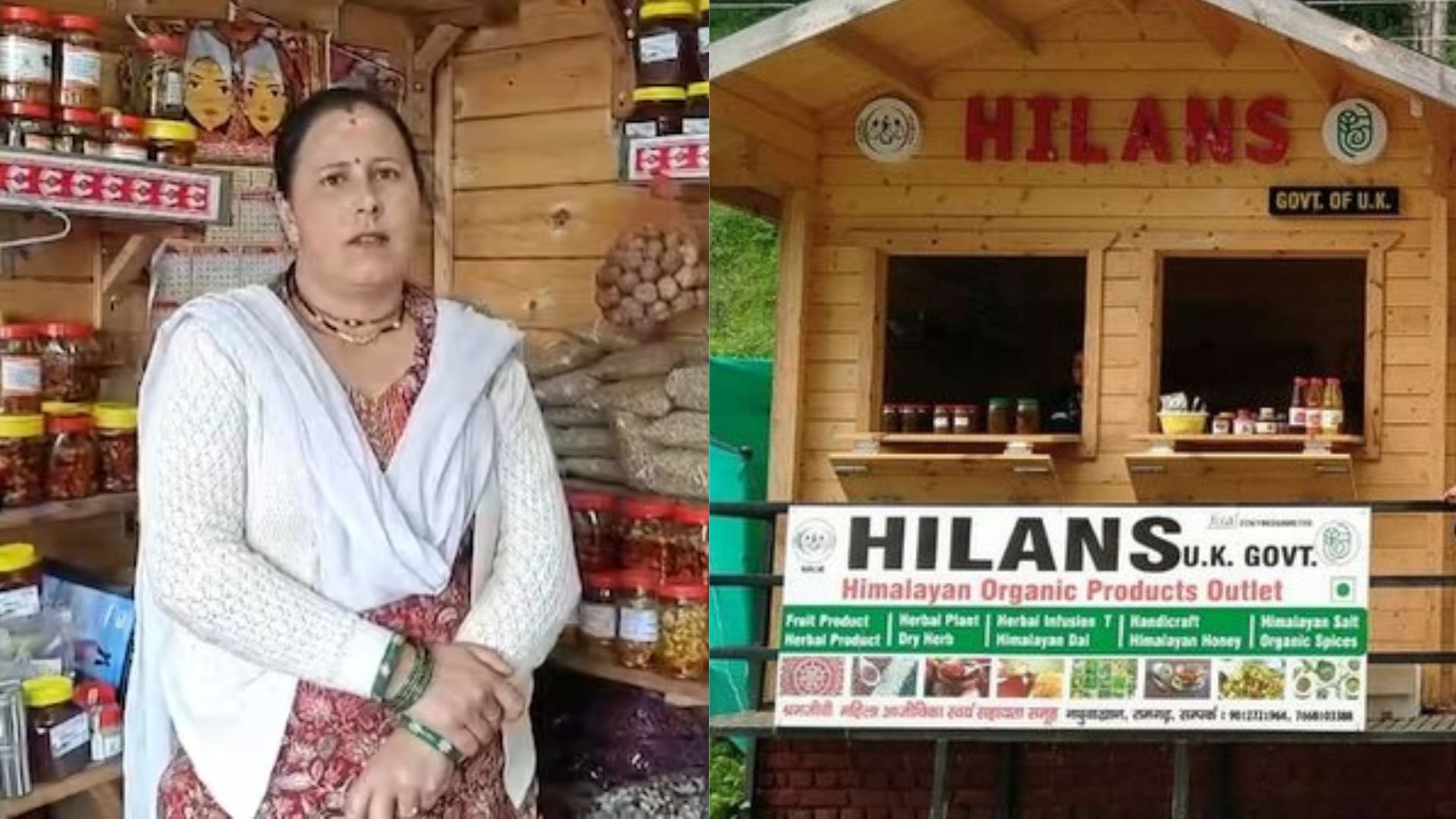
Nainital: Women empowerment: Sustainable livelihood: Traditional and local products from Uttarakhand’s hill regions are no longer limited to villages and nearby markets, Hilans outlets are providing a marketplace for these local goods while simultaneously creating self-employment opportunities for rural women. This enables women to increase their income and move towards financial self-reliance while staying in their own homes and villages.
Hilans facilitates market access for a variety of products, including hill grains, pulses, spices, organic goods, local food items, and products crafted by self-help groups. Significantly, the demand for these products is reaching beyond Uttarakhand and other parts of the country to international markets. This is giving a new identity to the region’s traditional farming practices, cuisine, and local craftsmanship.
Products ranging from Mandua and Jhingura to pickles and jams
Nirmala Joshi, who manages the Hilans outlet at Hanumangarhi in Nainital, explains that women from numerous self-help groups are associated with the outlet. These women are creating a variety of products using locally available hill grains and food ingredients. She explained that women are producing over 20 types of products, including Mandua (finger millet) flour, Ragi flour, red rice, Jhingura (barnyard millet) rice, mixed lentils, honey, Mandua snacks, pickles, jams, and Aipan (traditional folk art), which are being made available to customers through ‘Hilans’ outlets. Nirmala Joshi mentions that she secured this outlet through the Bhimtal block and is receiving a positive response from customers. Women from various self-help groups are associated with the initiative, participating in the entire process from production to bringing the goods to market.
Employment for women while staying in the village
Rural women are the primary beneficiaries of initiatives like ‘Hilans’. Many women in hilly regions engage in farming and the production of traditional food items, but previously, a lack of direct market access meant they could not secure fair prices for their goods. Now, products prepared by self-help groups have access to an organized market. This is giving professional recognition to the women’s local skills while providing them with a source of income without having to leave their homes and villages. The sale of products such as pickles, jams, honey, and Aipan, alongside traditional grains like Mandua, Jhingura, and red rice, is driving up the demand for local produce.
Financial support for women through government schemes
Nainital ADM Vivek Rai explains that the government is running several schemes to strengthen women financially. Through the Rural Development and Urban Development departments, women are being linked to self-help groups and provided with self-employment opportunities. He noted that under these schemes, women receive initial funding to start or expand their businesses. Additionally, government support includes loan facilities; some schemes even offer interest-free loans. ADM Vivek Rai stated that the objective of these schemes is to empower women, make them financially self-reliant, and create opportunities for self-employment. Mountain products gaining new recognition.
Through Hilans outlets, products crafted by women from the mountain regions are finding access not only to local markets but to a much wider consumer base. This is enhancing the visibility of traditional hill food items and local products. While traditional grains such as Mandua (finger millet), Jhingura (barnyard millet), and red rice are making their way onto people’s plates, the women’s groups involved in producing them are finding a market for their hard work. Consequently, Hilans outlets are becoming more than just sales points, they are evolving into a medium for self-employment, self-reliance, and establishing a new identity for mountain products.